Music distribution through streaming: culture as an international business model (part 2)
by Alberto Arenal, Cristina Armuña, Sergio Ramos

Streaming ecosystem dynamics - value creation vs value capture
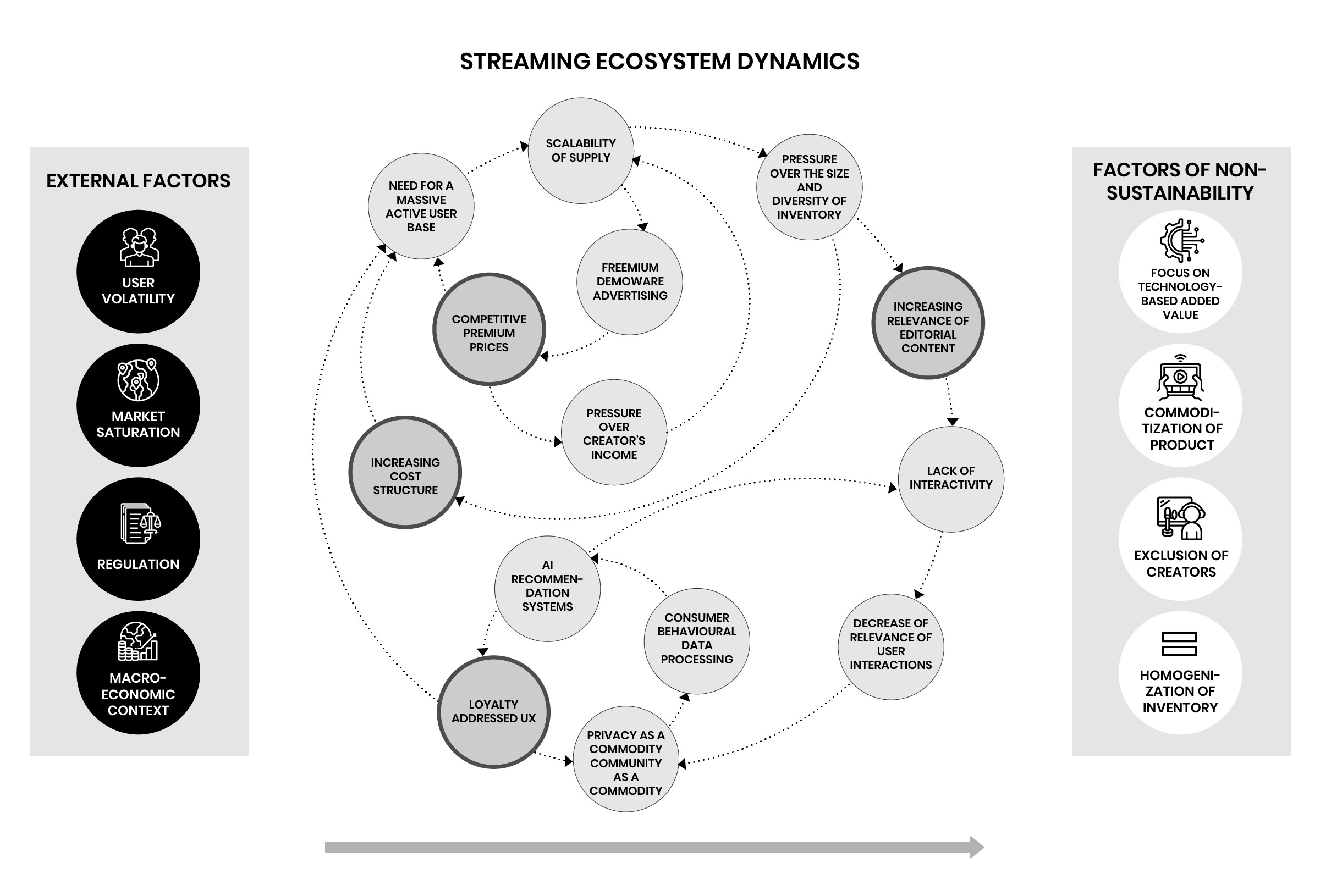
The most complicate issue to be addressed of the existing approach of DMSPs is the lack of sustainability of their business model derived from characteristic circularities within the value creation process (see exhibit).
There is an increasing body of evidence of this lack of future, almost present, economic sustainability. First, the increasing exclusion of some creators -performers- in favor of artists more docile to the subtleties of DMSPs business model and increase of revenues appears to be a direct consequence of the need to the unlimited enlarging of the size and diversity of inventory. In practice, these results in the prioritization of a short list of international artists who are trendy enough and that might end in being completely manipulated by the platform itself. Scarce room, if any, for new independent artists with own strategies to reach their target audience.
Second, the focus on technology, that plays a key role in the DMSP business model innovation such as AI-based recommendation systems, allows for an increasing success in the matching of supply and consumers’ preferences and profile. While this might appear as a legitimate objective, in reality it uses information asymmetries to the DMSP unfair advantage and, as a consequence, the creation of value is displaced from creative diversity to customization at the distribution level. Worst, the confluence of a loyalty-addressed user experience to international “subdued” artists and an unlimited growing inventory results in a vicious circle that generates an additional pressure to produce value through the exploitation of users’ behavioral data. Another consequence of that is the promotion by DMPs of modes of consumption that lack interactivity in the content experience and the increasing relevance of editorial content.
The overall outcome, as it has been anticipated, is the commoditization of music and the destruction of its "per-se” value. To this regard, it is worth to insist that the homogenization of inventory is a direct consequence of the “market-centric” model that puts gross revenue into a hotchpot distributed among rights-holders, according to the overall audience of the titles by market. Paradoxically, under the logics of the current digital music business model, the size and diversity of the inventory are not functions of value.
It is a sad logic. With performers excluded from the value creation process, and revenue calculation dissociated from the actual interaction between performer and customer, music content becomes valueless. The relevance of different forms of fraud in the DMSPs current environment or music generated by AI are observable symptoms of this overarching commoditization process.
As some analysts have recently pointed out, now music business has become a zero-sum game, that is, one in which for every winner there is a loser. Creators, platforms and big record labels and publisher companies are competing among themselves and almost every success is at the expense of other stakeholders.
Towards a new approach to music streaming
Policymakers and regulators are increasingly aware of the abuses of current music streaming business models and the threats to culture from its lack of sustainability. Partial remedies are slowly being deployed with two main trends in the most developed markets.
Some countries, such as Canada or France, have proposed a tax on music streaming platforms revenues to support local creative content.
Other countries have preferred a more market-oriented approach to include the idea of equitable remuneration in digital music streaming. An approach based on the existing experience from public communication in terrestrial radios. For instance, in 2020, the United Kingdom Parliament started a study on the streaming market, with some relevant insights in terms of analysis, but still without specific measures.
At European Union level, the transposition of Directive 2019/790 on copyrights and related rights opens the window to any of these new approaches, but at the time of writing Spain appears as the unique meaningful market with some type of equitable remuneration scheme for streaming platforms.
However, issues with digital music streaming run deeper than taxation or, even, equitable remuneration.
As business model level, there is a need of alignment between value creation and value capture in the audio streaming business model. The situation of session musicians is particularly unfair. They sustain the music industry, but they do not participate in its digital success. And this is only looking to performers, but authors and composers are also claiming for a fairer market in music streaming.
In reality, there are few incentives to change the landscape neither from the perspective of platforms and record companies nor from the policy side in main markets. Even the proposed improvements have been originated on spurious and particular interests. For example, during the first semester of 2023, the three CEOs of Sony Music, Warner Music and Universal Music have claimed for a reshuffling in streaming distribution model. Behind this claiming there are just threats to their market position: streaming revenues deceleration after the explosion of usage during the pandemics; the loss of market share in favor of independent -and fairer- players; and of course, the challenges related to artificial intelligence.
Solution seems to be far also from the policymaking perspective. While the music hits are more and more global in terms of consumption, almost each country is applying their own regulation terms and there are no signs for a common framework. At international level, WIPO efforts to find a solution face difficulty and even blockages derived from national strategic interests played at international level.
All in all, thinking about solutions in global streaming market probably involves questioning the whole music industry ecosystem. Its apparent maturity in the pre-digital days only hide the complicate relationships between business models and culture. Now, in the digital era, these malfunctioning has become more evident, broader, and threats to erase minority preferences and independent creators. It is already obvious that market is unable to correct itself. Therefore, it is time for public action, but not just for partial solutions, but looking for international agreements to help keep local cultures, minority genres and value from grassroots creativity alive.